
Who we are
GraphicsVision.AI (GVAIN) is an international non-profit research and innovation network operating at the intersection of artificial intelligence, computer vision, and advanced digital technologies. Bringing together leading research institutions and industry-driven organisations, GVAIN serves as a collaborative platform for developing and scaling cutting-edge technological solutions.
With a strong foundation in computer graphics, machine vision, and multimodal systems, GVAIN has evolved into a forward-looking AI network addressing emerging technological, industrial, and societal challenges. The network spans multiple countries and connects a diverse ecosystem of researchers, engineers, and innovation actors.
Our Mission
GVAIN’s mission is to bridge research and industry by transforming advanced technological developments into scalable, impactful, and responsible solutions. The network contributes to the design, development, and deployment of AI-driven technologies aligned with European research priorities and societal needs.
Through collaborative research, strategic partnerships, and participation in international programmes such as Horizon Europe, GVAIN supports:
• the development of innovative AI technologies;
• the transfer of knowledge from research to industry;
• the creation of high-impact, multidisciplinary projects;
• the strengthening of Europe’s technological and innovation capacity.
Our Vision
In the technological domains in which we are active as a network, we consider technology as a relation between perception and cognition.
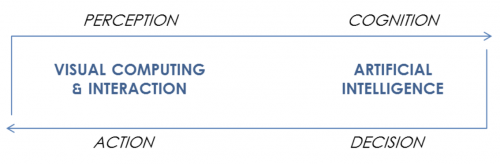
The fields of expertise of the partners include:
- Computer Graphics
- Computer Vision
- Visualisation & Simultation
- Digital Media
- HMI, User Perception, Interaction
- Face/Body Tracking, Activity Recognition
- Robotics and sensors
- Machine and Deep Learning
- Visual Analytics
- Language Processing
- Safety, Digital Security
- Smart IoT
- Simulation
- Autonomous Systems
Our Approach
GVAIN adopts a holistic approach to innovation, combining technological excellence with ethical, societal, and environmental considerations.
In particular, the network:
• promotes responsible and trustworthy AI, aligned with European policy and regulatory frameworks;
• integrates ethical, legal, and social aspects (ELSA) into research and innovation activities;
• advances ESG principles, including sustainability, low-carbon innovation, and gender equality, as core components of technological development;
• supports the development of AI for next-generation systems, including energy systems and intelligent infrastructures;
• supports interdisciplinary collaboration across AI, data science, human factors, and digital systems.
This approach ensures that innovation is not only technologically advanced, but also inclusive, transparent, and socially responsible, while contributing to emerging European priorities on low-carbon and net-zero technologies.
Our Impact
GVAIN contributes to addressing key societal and industrial challenges through the application of AI technologies in areas such as:
• safety and security;
• smart systems and IoT;
• autonomous and intelligent systems;
• digital media and immersive technologies;
• data-driven decision support.
• AI-enabled next-generation energy systems and intelligent infrastructures
Particular attention is given to the role of AI in public services, operational environments, and critical infrastructures, where reliability, fairness, and accountability are essential.
GVAIN also contributes to the development of low-carbon and sustainable technological solutions, supporting European initiatives aimed at accelerating the transition towards net-zero and energy-efficient systems, including through the integration of impact assessment approaches in technology design and deployment.
By fostering collaboration between research and industry, GVAIN supports the development of solutions that contribute to resilient, sustainable, and inclusive communities.
Strategic Alignment with European Policy Frameworks
GVAIN actively aligns its activities with emerging European policy initiatives in the fields of sustainability, industrial transformation, and digital innovation. In particular, the network follows recent developments such as the EU Industrial Accelerator Act and related policy frameworks promoting low-carbon, net-zero, and energy-efficient technologies.
Within this context, GVAIN emphasises the role of artificial intelligence as a key enabling technology for next-generation low-carbon systems, supporting:
• the optimisation of energy production, distribution, and consumption;
• the development of intelligent and adaptive infrastructures;
• the integration of impact assessment methodologies into technology design and deployment;
• the acceleration of industrial transition towards sustainable and resilient systems.
This policy-aware approach strengthens GVAIN’s capacity to contribute to European strategic priorities, while ensuring that technological innovation remains aligned with regulatory, environmental, and societal expectations.
Our Values
We strongly believe in team spirit. As such, our network members and us regularly conduct face-to-face meetings, typically at one of our members’ sites, making use of public events, e.g. H2020 or other conferences, and through frequent online meetings.
We conduct all our activities with dedication and professionalism. We consider reliability as a key quality in any professional and personal context.
We seek to support all of our members on an equal basis, and to develop activities that are typically of value to all of them and not just one or a few.
We are an open-minded, multi-cultural community. As such, we welcome the participation of any institution and people that share the same values.
Our network currently aggregates eight partners from three continents.

Our Team

Dr. Jorge Posada
President

Prof. Dr. Didier Stricker
Managing Director
GENDER EQUALITY PLAN
graphicsvision.ai · GVAIN
2026 – 2028
Compliant with Horizon Europe GEP Eligibility Requirements
1. Organisation Profile & Commitment
graphicsvision.ai (GVAIN) is a European research and innovation organisation active in the fields of artificial intelligence, computer vision, and responsible digital technologies. The organisation operates through international collaboration between research, industry, and applied innovation partners and aims to contribute to trustworthy, human-centric digital technologies through participation in European research and innovation programmes and strategic partnerships.
This Gender Equality Plan (GEP) has been developed in accordance with the Horizon Europe GEP eligibility criterionon Gender Equality Plans. It constitutes a formal, publicly available commitment to gender equality in our organisational practices, governance, and research activities. It covers the period January 2026 to December 2028 and will be reviewed annually.
Beyond compliance with Horizon Europe eligibility requirements, this Gender Equality Plan also aims to strengthen GVAIN’s internal institutional capacity to integrate gender equality principles across governance, recruitment practices, collaboration networks, and research and innovation activities.
| Formal Commitment | This document is formally endorsed by the GVAIN leadership. It is publicly accessible on the GVAIN website (graphicsvision.ai). |
2. Status Quo Assessment
As a recently established innovation network operating in the AI and computer vision domain, GVAIN acknowledges the structural gender imbalances that characterise the broader technology and research sectors. The following assessment reflects the organisation’s current state and forms the evidence base for the actions defined in Section 4.
2.1 Workforce & Governance Composition
GVAIN is in its early development phase. The founding team and advisory board currently have a gender imbalance, with women underrepresented particularly in technical and senior governance roles — reflecting patterns common to the AI sector (European Commission, She Figures 2024). GVAIN commits to tracking this data on a sex-disaggregated basis from 2026 onwards. From 2026 onwards, GVAIN will implement a structured internal system for collecting sex-disaggregated data related to staff and collaborators, governance bodies, advisory structures, project teams, recruitment processes, and professional development opportunities. These data will provide the baseline for monitoring gender equality progress throughout the implementation of this plan.
2.2 Organisational Culture & Processes
GVAIN does not yet have formalised HR policies, recruitment guidelines, or parental support measures. Gender considerations have not yet been systematically applied to research content, project design, or communication materials. These gaps are acknowledged and directly addressed in this GEP. GVAIN also recognises the importance of integrating gender equality principles into its internal operational practices, including recruitment procedures, collaboration agreements, and organisational governance processes. Over time, relevant principles will be incorporated into internal operational documents and working procedures.
2.3 Research & Innovation Content
AI systems — particularly computer vision technologies — carry documented risks of gender bias in training data, model design, and deployment. GVAIN recognises its particular responsibility in this area as an AI-focused network and commits to embedding gender and intersectionality analysis into its research and innovation outputs. In the context of AI and computer vision technologies, particular attention will be given to potential gender bias in datasets, algorithms, training environments, and technological outputs. Addressing such risks forms part of responsible AI development and aligns with European policy frameworks for trustworthy artificial intelligence.
3. Governance, Resources & Accountability
3.1 Dedicated Responsibility
GVAIN appoints a Gender Equality Officer (GEO) responsible for coordinating the implementation of this GEP, monitoring progress, and reporting to leadership. The GEO role is integrated into the newly established Ethics Advisor function for GVAIN, ensuring alignment between gender equality, AI ethics, and responsible innovation.
The GEO will also coordinate the annual monitoring of this GEP, support internal data collection, and provide recommendations to leadership on potential updates to actions or targets.
3.2 Resources
GVAIN commits to allocating appropriate organisational resources to support the implementation of this GEP. This includes dedicated working time for the Gender Equality Officer (integrated within the Ethics Advisor role), resources for awareness-raising and training activities, capacity for internal monitoring and data collection, and leadership engagement in annual review processes. As the organisation develops, resource allocation will be reassessed and adjusted accordingly.
3.3 Stakeholder Engagement
Implementation of this GEP engages all organisational stakeholders, including the founding team, advisory board, member organisations, and external project partners. Gender equality considerations will be included in all new partnership and consortium agreements. Where feasible, the implementation and review of the GEP will include consultation with staff members, collaborators, and advisory participants in order to gather feedback and identify emerging priorities related to equality, inclusion, and organisational culture.
3.4 Transparency & Public Availability
This GEP is published on the GVAIN website. Annual progress reports will be made publicly available. GVAIN will report on GEP implementation in all Horizon Europe project periodic reports as applicable.
4. Action Plan 2026–2028
The following priority areas and concrete actions address the gaps identified in the status quo assessment. Each action is assigned a responsible party and implementation timeline.
| Area | Action | Target | Timeline | Responsible |
| Work-Life Balance | Develop and publish a flexible working and parental leave policy applicable to all GVAIN staff and contracted individuals | Policy published | Q2 2026 | GEO / Leadership |
| Work-Life Balance | Include work-life balance provisions in all freelance and service contracts | 100% of new contracts | Q1 2026 | Leadership |
| Recruitment | Adopt gender-aware recruitment guidelines: gender-neutral language in all job postings, diverse interview panels, blind shortlisting where possible | Guidelines in use | Q2 2026 | GEO |
| Recruitment | Set a target of minimum 40% women in advisory board and working group memberships | 40% by end 2027 | 2026–2027 | Leadership |
| Career & Leadership | Establish mentoring and professional development opportunities accessible to all genders, with proactive outreach to women | Programme launched | Q3 2027 | GEO |
| Career & Leadership | Ensure gender balance in speaker and expert invitations for GVAIN events, webinars, and publications | ≥40% women speakers | Ongoing from Q2 2026 | Comms team |
| Training | Deliver annual unconscious bias and inclusive culture training for all staff | 100% participation | Q4 2026 | GEO |
| Data & Reporting | Collect and monitor sex-disaggregated data on membership, governance, events, and project teams | Annual data report | From Q3 2026 | GEO |
| Data & Reporting | Conduct annual GEP progress review and publish summary on GVAIN website | Annual publication | Q1 2027, 2028 | GEO / Leadership |
| Research Content | Develop and apply a gender & intersectionality checklist for all GVAIN-affiliated research projects and funded activities | Checklist adopted | Q3 2026 | Research leads |
| Research Content | Promote gender dimension in AI as a GVAIN advocacy priority in EU policy forums and publications | Min. 1 policy output/year | 2026–2028 | Comms / GEO |
| Anti-Harassment | Adopt and publish a Code of Conduct addressing gender-based harassment and discrimination, with a clear reporting mechanism | Code published | Q2 2026 | Leadership / GEO |
| Anti-Harassment | Designate a confidential contact person for reporting concerns; communicate this through all GVAIN channels | In place | Q3 2026 | Leadership |
| Recruitment | Monitor recruitment processes on a sex-disaggregated basis where feasible (applications, shortlist and selection stages). | Recruitment monitoring introduced | Q3 2026 | GEO / Leadership |
| Governance | Gradually integrate gender equality principles into internal operational documents and organisational procedures. | Relevant documents updated | 2026–2027 | Leadership |
| Communication | Promote inclusive language and balanced representation in external communication materials, events, and public outputs. | Inclusive communication guidelines applied | 2026–2027 | Comms / GEO |
Table 1 – GVAIN Gender Equality Action Plan 2026–2028
5. Gender Dimension in Research & Innovation Content
As an AI and computer vision network, GVAIN has a specific responsibility to integrate gender analysis into the technological outputs it supports and promotes. Computer vision systems trained on biased datasets have been shown to produce discriminatory outcomes — in facial recognition, object detection, medical imaging, and automated decision-making — disproportionately affecting women and other marginalised groups.
5.1 GVAIN Commitments on Gender in AI Research
- Promote gender-balanced and diverse training datasets as a standard of responsible AI development.
- Advocate for gender impact assessments in computer vision and AI systems developed or endorsed by GVAIN members.
- Include gender analysis as a required element in research proposals submitted by or involving GVAIN.
- Engage with EU AI Act compliance requirements and ERA guidelines on gender-sensitive AI.
- Collaborate with ethics, social science, and gender studies experts in multidisciplinary project design.
- Encourage the identification and mitigation of gender-related bias during data collection, annotation, model testing, validation, and deployment phases.
5.2 Integration in Funded Projects
Where GVAIN is a partner or coordinator in Horizon Europe or other EU-funded projects, the gender dimension in research content will be addressed in line with the European Commission’s guidance, including the Gendered Innovations methodology. Project proposals will include a dedicated section on how gender and sex analysis informs research design, methodology, and expected impact.
6. Monitoring, Evaluation & Review
Progress against this GEP will be measured using the following key performance indicators (KPIs), reported annually by the Gender Equality Officer:
| Indicator | Baseline (2026) | Target (2028) | Measurement |
| Women as invited experts/speakers at GVAIN events | Not yet tracked | ≥40% | Event records |
| Staff/contractors completing gender training | 0% | 100% | Training records |
| Research outputs applying gender checklist | 0 | 100% of new projects | Project review |
| Contracts including work-life balance provisions | 0% | 100% | Contract audit |
| GEP annual review published publicly | N/A | Every year (2026, 2027) | Website publication |
| Code of Conduct in place | Not yet | Yes (Q2 2026) | Policy register |
| Women in advisory structures | To be established | ≥40% | Governance records |
| Sex-disaggregated recruitment monitoring | Not yet implemented | monitoring introduced | Gecruitment records |
| Internal procedure for reporting harassment/discrimination | Not yet established | procedure operational | internal policy documentation |
Table 2 – Key Performance Indicators for GEP Monitoring
The GEP will be formally reviewed by GVAIN leadership in Q1 of each year (2027 and 2028). Review findings will be used to update targets, add new actions where needed. A final evaluation report will be produced at the end of 2028 to inform the next GEP cycle. Findings from the annual monitoring process will inform adjustments to the Action Plan and may contribute to the development of the next Gender Equality Plan cycle beyond 2028.
7. Endorsement & Signatures
This Gender Equality Plan has been formally adopted by the GVAIN leadership and constitutes an organisational commitment binding on all activities, projects, and partnerships undertaken under the GVAIN name. The present Gender Equality Plan enters into force upon approval by GVAIN leadership and will guide organisational practices during the 2026–2028 implementation period.
| Organisation Representative | Gender Equality Officer | |
| Didier Stricker, Managing Director
23.03.2026
|
Eirini Keremidou, Senior Research Fellow
23.03.2026
|
Document version: 1.0 | Date of adoption: March 2026 | First annual review: January 2027 | Final review of current cycle:: January 2028 | Published at: graphicsvision.ai
AI for Low-Carbon and Net-Zero Systems
GVAIN Positioning on Sustainable and Responsible AI
1. Introduction
The transition towards low-carbon and net-zero economies represents one of the most significant challenges and priorities for Europe and the global community. Recent policy developments, including the EU Industrial Accelerator Act, emphasise the need to accelerate the deployment of sustainable, energy-efficient, and resilient technological systems, supported by robust impact assessment mechanisms.
Within this context, artificial intelligence (AI) emerges as a key enabling technology, capable of supporting the optimisation, monitoring, and transformation of complex energy and industrial systems.
GVAIN positions itself at the intersection of AI, sustainability, and industrial innovation, contributing to the development of next-generation solutions aligned with environmental, societal, and governance (ESG) principles.
2. AI as an Enabler of Low-Carbon Systems
Artificial intelligence can play a critical role in enabling the transition towards low-carbon and energy-efficient systems by supporting:
• optimisation of energy production, distribution, and consumption;
• predictive analytics for energy demand and resource allocation;
• real-time monitoring of energy infrastructures and environmental conditions;
• intelligent management of decentralised and micro-grid systems.
These capabilities enable more efficient use of resources, reduction of emissions, and improved resilience of both urban and rural energy infrastructures.
3. AI-Driven Next-Generation Energy Systems
GVAIN emphasises the development of AI-enabled next-generation energy systems, including:
• decentralised energy architectures and micro-grid solutions;
• integration of renewable energy sources into intelligent infrastructures;
• adaptive and self-optimising energy networks;
• data-driven management of energy systems across different scales.
Such systems support both large-scale urban environments and flexible deployment in rural or resource-constrained areas, contributing to energy resilience and sustainability.
4. Integrating ESG and Impact Assessment
A key dimension of low-carbon innovation is the integration of structured impact assessment methodologies. In line with European policy priorities, GVAIN incorporates:
• environmental impact assessment, including CO₂ footprint considerations;
• social impact assessment, addressing accessibility, inclusion, and societal acceptance;
• governance frameworks ensuring transparency, accountability, and regulatory compliance.
These approaches enable the systematic evaluation of technological solutions, ensuring that innovation is aligned with both sustainability goals and societal expectations.
5. Towards Sustainable and Resilient Industrial Ecosystems
Beyond energy systems, AI contributes to the broader transformation of industrial ecosystems by:
• enhancing efficiency and sustainability in manufacturing processes;
• supporting data-driven decision-making for resource optimization;
• enabling predictive maintenance and lifecycle management of systems;
• contributing to the development of resilient and adaptive infrastructures.
This aligns with European priorities for strengthening industrial resilience, technological sovereignty, and sustainable growth.
6. Conclusion
By integrating artificial intelligence with low-carbon and sustainability objectives, GVAIN contributes to a new paradigm of responsible and impact-driven innovation.
Through its interdisciplinary and ESG-oriented approach, GVAIN supports the development of technological solutions that are not only advanced, but also aligned with environmental goals, societal needs, and regulatory frameworks shaping the future of Europe’s digital and industrial transformation.